Top 20 Fastest Road Cars for 2026: An Analysis of Automotive Pinnacle Performance
While top speed is a readily available metric for most road vehicles, its practical relevance for the average driver is often limited. Modern passenger cars can comfortably achieve speeds well beyond typical highway limits, rendering extreme top-end performance largely theoretical outside of controlled track environments or de-restricted autobahns. However, for high-performance vehicles, top speed transcends mere utility, serving as a significant benchmark for engineering prowess and a potent source of competitive prestige.
Automakers have long utilized top speed figures as a definitive statement of their technological and performance capabilities. Achieving extraordinary speeds in a road-legal vehicle presents a formidable engineering challenge, requiring meticulous development and refinement. The pursuit of a position among the world’s fastest road cars offers manufacturers unparalleled recognition, elevated status, and enhanced credibility.
The lineage of high-speed automotive achievement can be traced back to early racing cars adapted for road use, exemplified by manufacturers like Bentley and Bugatti in their Le Mans endeavors. In the contemporary automotive landscape, however, the distinction between dedicated motorsport machines and road-legal supercars has become more pronounced. To contend for the title of the fastest road car, manufacturers must now invest substantial resources and expertise specifically into the development of these elite models.
The 1990s witnessed a notable escalation in the pursuit of the 200mph threshold, with iconic vehicles such as the Ferrari F40, Porsche 959, Jaguar XJ220, and the McLaren F1 captivating enthusiasts with their advanced powertrains and aerodynamic designs. These vehicles achieved unprecedented top speeds for production cars equipped with road registration.
Current efforts are focused on breaching the 300mph barrier, a milestone of exponentially greater complexity for conventional automotive design. The mere possibility of achieving such speeds in a road-legal production car is a testament to remarkable technological advancements. The rapid evolution of electric vehicle (EV) technology has also significantly impacted this segment, enabling newer manufacturers to challenge established brands with highly competitive performance figures.
The roster of the world’s fastest road cars is in a perpetual state of flux, driven by continuous innovation and the introduction of new models. This compilation presents the top 20 rankings based on verified top speeds, excluding duplicate models or significantly modified variants.
The Leading Pack:
McLaren F1
Top Speed: 240.1 mph
Estimated Price: £15 million+
The McLaren F1, a legend for those predating the 21st century, set a production car world record in 1998 at 240.1 mph. Its naturally-aspirated V8 engine and manual gearbox remain benchmarks for enthusiast appeal. While its modern successor, the GMA T50, is anticipated to be equally or more rapid, official specifications are yet to be released.
W Motors Fenyr Supersport
Top Speed: 245 mph
Price: £1.4 million
Following the Lykan HyperSport, W Motors’ Fenyr SuperSport, based in Dubai, is also credited with a top speed of 245 mph. It features a twin-turbocharged flat-six engine sourced from Porsche tuner Ruf and incorporates bespoke materials, including diamond and sapphire accents in the headlights, for a distinctive aesthetic.
Saleen S7 Twin Turbo
Top Speed: 248 mph
Price: £500,000
Introduced in 2005, the Saleen S7 Twin Turbo, with its 750 bhp and claimed top speed of 248 mph, aimed to surpass the McLaren F1. This all-American V8 machine, powered by twin turbos, represented a significant engineering feat, though its claimed top speed has remained unproven, despite some close attempts.
Koenigsegg Gemera & CCXR
Top Speed: 248 mph
Price: £2 million
Koenigsegg, a recurring presence on this list, is represented by the Gemera and CCXR, both achieving a top speed of 248 mph (400 km/h). The Gemera is a hybrid marvel with three electric motors contributing to its immense power, alongside a combustion engine. The older CCXR, with its supercharged V8 and aerodynamic design, matches this speed, albeit with less technological complexity.
Aspark Owl
Top Speed: 249 mph
Price: £2.5 million
The Aspark Owl, a product of a burgeoning niche in hand-built hypercars, exemplifies the emergence of new players in the ultra-performance segment. This Japanese battery-electric model boasts an impressive 1.72-second 0-60 mph acceleration claim, potentially making it the fastest accelerating production car. Its quoted top speed is 249 mph, aided by a relatively light 64 kWh battery pack.
Ultima RS
Top Speed: 250 mph
Price: £130,000
The Ultima RS stands out as the most affordable option, being a kit car with a claimed top speed of 250 mph. Its performance is achieved through a combination of extreme lightweight construction and a highly tuned Corvette V8 engine producing 1,200 bhp, emphasizing raw power-to-weight ratio.
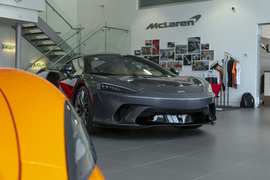
McLaren Speedtail
Top Speed: 250 mph
Price: £2.1 million
According to McLaren, the Speedtail achieved 250 mph over 30 times during testing at the Kennedy Space Center. This hybrid model, limited to 106 units, shares the F1’s three-seater configuration and boasts advanced aerodynamic features.
Czinger 21C V Max
Top Speed: 253 mph+
Price: £1.5 million
The Czinger 21C V Max combines a powerful hybrid powertrain with a total output of 1,233 bhp and a focus on aerodynamic efficiency. It achieves 0-62 mph in 1.9 seconds, with the V Max variant optimizing for top speed by removing drag-inducing aero elements.
Koenigsegg Regera
Top Speed: 255 mph
Price: £2.6 million
The Koenigsegg Regera, a hybrid powerhouse generating nearly 1,500 bhp, represents the brand’s ongoing pursuit of top-speed records. Its innovative single-speed gearbox, made possible by the plug-in hybrid system, is a notable engineering achievement. The Regera also holds a 0–249–0 mph acceleration and braking world record.
SSC Ultimate Aero
Top Speed: 256.18 mph
Price: £500,000
The SSC Ultimate Aero, powered by a 1,183 bhp twin-turbo V8, briefly held the title of the world’s fastest car, surpassing the Bugatti Veyron with a verified top speed of 256.18 mph. This record was set on a public road, and the car offered a raw driving experience with the absence of electronic driver aids.
Rimac Nevera/Nevera R
Top Speed: 258 mph / 268 mph
Price: £2.4 million
The Rimac Nevera is recognized as the fastest electric hypercar, achieving 258 mph with its 1,888 bhp powertrain. The recently released Nevera R, with 2,078 bhp, pushes the top speed to 268 mph and claims the title of fastest accelerating road car, with 0-62 mph in 1.8 seconds.
Bugatti Veyron
Top Speed: 268 mph
Price: £1 million
Despite its age, the Bugatti Veyron remains a highly respected name in the automotive world. The Veyron Super Sport variant, with 1,183 bhp, achieved a top speed of 268 mph, a figure that still challenges many contemporary hypercars. Its sub-2.5-second 0-62 mph time is remarkable even by today’s standards.
Hennessey Venom F5
Top Speed: 271.6 mph (tested)
Price: £1.7 million
Hennessey’s Venom F5 has surpassed 270 mph in testing, reaching 271.6 mph. With a massive 1,817 bhp twin-turbo V8, Hennessey aims for a top speed of 311 mph. The car’s 0-62 mph time is affected by its rear-wheel drive, but its straight-line acceleration from 0-249 mph is exceptional.
Bugatti Tourbillon
Top Speed: 277 mph (estimated)
Price: £3.5 million+ (estimated)
The upcoming Bugatti Tourbillon is poised to join this elite list with its hybrid system, combining a V16 engine to produce over 1,770 bhp. Given Bugatti’s legacy and engineering expertise, the Tourbillon is expected to be a formidable contender upon its 2026 release.
Koenigsegg Agera RS
Top Speed: 277.87 mph
Price: £3.5 million
In 2017, the Koenigsegg Agera RS set a new world speed record on a closed public highway in Nevada, reaching 277.87 mph. This achievement further solidified Koenigsegg’s reputation for pushing the boundaries of automotive performance.
Bugatti Mistral
Top Speed: 282.05 mph
Price: £5.2 million
The Bugatti Mistral, limited to 99 units, holds the title of the fastest production convertible. During its record run in 2024, it achieved 282.05 mph, powered by Bugatti’s renowned quad-turbocharged 8-litre W16 engine.
SSC Tuatara
Top Speed: 282.9 mph (two-way average)
Price: £1.5 million
After initial controversy surrounding its speed claims, the SSC Tuatara officially achieved a two-way average of 282.9 mph in 2021. Its 1,750 bhp V8 engine and lightweight carbon fiber construction contribute to its impressive performance, with all power sent to the rear wheels.
Bugatti Chiron Super Sport 300+
Top Speed: 304.8 mph
Price: £3 million
The Bugatti Chiron Super Sport 300+ is a landmark vehicle, having broken the 300 mph barrier with a recorded speed of 304.774 mph. This achievement was facilitated by an enhanced 8.0-litre W16 engine producing 1,578 bhp, along with significant aerodynamic modifications, including a ‘Longtail’ rear end.
Koenigsegg Jesko Absolut
Top Speed: 310 mph (targeted)
Price: £2.3 million (approx.)
Koenigsegg’s Jesko Absolut is engineered with the explicit goal of being the fastest Koenigsegg ever produced. This low-drag variant of the Jesko features extensive aerodynamic refinements and a tuned 5.0-litre turbocharged V8 producing 1,600 bhp, with a targeted top speed of 310 mph.
Yangwang U9 Xtreme
Top Speed: 308 mph
Price: £250,000+
The Yangwang U9 Xtreme has achieved an astonishing 308 mph, a record set by a sub-£1 million electric vehicle. This performance is attributed to aerodynamic enhancements, four high-output electric motors delivering 2,978 bhp, and an advanced 1,200V architecture for rapid power transfer.