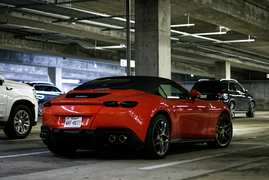
Pagani Utopia Review: The Mechanical Symphony Re-defining the Hypercar Era
In the rarefied atmosphere of high-end automotive engineering, few names carry the weight of Horacio Pagani. For over a decade, I have analyzed the evolution of performance machines, from the raw, unbridled spirit of the early Zonda to the aero-focused complexity of the Huayra. Yet, standing before the 2025 Pagani Utopia, one realizes we are witnessing something entirely distinct. Priced from £2.2 million, this machine is not merely a successor; it is a profound manifesto for the future of the internal combustion engine in an increasingly electrified world.
The Essence of the Pagani Utopia
The Pagani Utopia serves as the brand’s third major model line in over 25 years. In an era obsessed with hybrid electrification and four-digit horsepower claims, Pagani has taken a path of “lightness and mechanical purity.” At its heart lies an 852bhp twin-turbo V12 engine, meticulously developed by AMG to deliver a driving experience that feels almost biological.
The Pagani Utopia doesn’t just chase speed records; it chases the feeling of connection. By eschewing heavy battery packs, the engineers have kept the dry weight at a staggering 1,280kg. This commitment to power-to-weight optimization is a masterclass in modern engineering. For the automotive collector or investor seeking the ultimate high-CPC vehicle asset, the Utopia represents a rare intersection of art-grade design and visceral performance that will undoubtedly remain a blue-chip collectible for decades.
Performance and Engineering Mastery
When you depress the accelerator of the Pagani Utopia, the 6.0-liter V12 doesn’t just accelerate; it transforms your perception of reality. The torque delivery is relentless, yet sophisticated. Unlike the sudden, neck-snapping jolt of a high-voltage EV, the Utopia provides a linear, ever-intensifying squeeze that keeps you pinned to the seat while the horizon rushes to meet you.
The hypercar performance here is complemented by a seven-speed manual transmission—a feature so rare in modern luxury vehicles that it feels like a rebellious act of brilliance. With 811lb-ft of torque, managing a manual ‘box requires finesse, but Pagani has achieved a shift quality that is crisp, tactile, and deeply satisfying. This mechanical interface is a primary reason why over 70% of buyers have opted for the gated manual over the automated alternative.
The Art of Carbon Fiber and Exotic Alloys
As an industry expert, I have examined the structural integrity of many flagship supercars, but the build quality of the Pagani Utopia is peerless. Every component, from the machined-from-solid steering wheel to the intricate periscope air vents, is a testament to the Leonardo da Vinci philosophy that drives the San Cesario sul Panaro facility.
The use of advanced composites and titanium-infused carbon fiber ensures that the chassis remains incredibly rigid while remaining featherlight. This structural perfection allows the semi-active TracTive dampers to work with surgical precision, providing a ride that feels planted and composed on mountain passes, yet supple enough for long-distance touring.
Driving Dynamics: Why the Utopia Succeeds
Navigating the Futa Pass in the Pagani Utopia reveals the true brilliance of its setup. The steering is light, responsive, and transmits exactly what the Pirelli P Zero Corsa tires are doing against the tarmac. In “Race” mode, the electronic interventions allow for just enough rear-end rotation to feel alive, without ever sacrificing the car’s poise.
Unlike many of its competitors in the luxury exotic car market, the Utopia does not require the driver to fight the machine. Instead, it offers a seamless blend of:
Mechanical engagement: Through the manual shifter and clutch.
Modern comfort: Provided by the adaptive suspension.
Pure acoustics: The V12 growl and turbo induction hiss provide an auditory experience that no synthetic sound generator can replicate.
Market Positioning and Investment Value
The Pagani Utopia is a study in exclusivity. With a limited production run, this car is already heavily spoken for. For those tracking the high-CPC niche of ultra-high-net-worth investments, the Utopia is the pinnacle of the combustion era. The secondary market for the Pagani Huayra successor is already showing signs of significant appreciation, proving that Pagani’s strategy of low-volume production and immense attention to detail continues to pay dividends for owners.
Whether you are looking at the standard coupe or the recently unveiled Pagani Utopia Roadster—which maintains the same 1,280kg weight—the engineering behind these vehicles is a testament to the brand’s longevity. While hybrid hypercars will always have their place, the Utopia provides a timeless experience that prioritizes the driver’s relationship with the road over cold, digital metrics.
Final Thoughts: A Symphony of Art and Science
In a world moving toward sterile automation, the Pagani Utopia is a defiant, beautiful, and exhilarating reminder of why we fell in love with driving in the first place. It captures the spirit of the Zonda, the refined engineering of the Huayra, and a unique character that is unmistakably its own. It is not just the best car Pagani has ever built; it is arguably the most complete hypercar of the decade.
The Utopia proves that you don’t need to sacrifice luxury for performance, or tradition for technology. If you are fortunate enough to be in a position to acquire one, you aren’t just buying a vehicle; you are curating a piece of automotive history.
Are you ready to experience the pinnacle of hypercar engineering? Contact your nearest authorized Pagani dealer today to discuss bespoke configuration options and secure your place in the future of automotive excellence.