Track-Born Power: The Ultimate List of Production Vehicles with Genuine Motorsport DNA
There is an electric, visceral connection that occurs when you press the throttle of a vehicle engineered by racing specialists. It isn’t merely about horsepower figures or sleek aesthetics; it’s about the soul of the machine. True motorsport DNA is forged in the high-stakes crucible of the racetrack, where milliseconds determine victory and engineering failure is never an option. When manufacturers choose to transplant these competition-derived power plants into road-going production vehicles, they offer enthusiasts a rare bridge between the paddock and the public highway.
As someone who has spent a decade analyzing high-performance automotive engineering, I have seen how the “Win on Sunday, Sell on Monday” philosophy continues to dictate the benchmarks of the industry. Integrating race-bred engines into street-legal cars isn’t just a marketing ploy—it is the ultimate expression of automotive technical prowess.
The Engineering Bridge: From The Paddock To Your Driveway
Why do manufacturers invest millions to bring race-grade tech to the showroom floor? Beyond the obvious boost in brand prestige and high-CPC market positioning, there is the functional necessity of innovation. Racing is the ultimate laboratory for durability, thermal management, and power-to-weight optimization.
Technologies like ceramic disc brakes, advanced paddle-shift dual-clutch transmissions, and complex forced-induction systems—all of which are now standard in premium sports cars—began their lives under the extreme stress of circuit racing. When a manufacturer adapts these systems for a mass-produced chassis, the driver benefits from a level of precision and reliability that typical passenger car development cycles simply cannot match. Below, we examine 10 iconic production vehicles that successfully blurred the lines between the checkered flag and the grocery store.
Alfa Romeo Montreal: A Prototype in Disguise
The Alfa Romeo Montreal remains one of the most aesthetically pleasing and technically intriguing cars of its era. Beneath its sharp, mid-century hood sits a 2.6-liter V8 engine directly descended from the Tipo 33 sports prototype. Designed to compete in the brutal world of endurance racing, the Montreal’s engine was retuned for street use while retaining its signature 7,000 RPM redline. This car serves as a perfect example of how motorsport DNA can transform a standard touring coupe into a spirited driver’s machine.
BMW M1 and the M-Division Legacy
BMW’s M-Division is synonymous with success on the track, and the M1 stands as the progenitor of this movement. Its M88 inline-six engine was a direct transfer from the BMW M1 ProCar series. This lineage continued into the E28 M5 and the legendary E30 M3. The E30 M3, in particular, utilized an S14 engine that borrowed heavily from the M12 Formula 1 block, creating a DTM-dominating force that remains a holy grail for collectors and driving purists alike.
Chevrolet Camaro ZL1: The Can-Am Terror
In the late 1960s, the battle for track supremacy was fierce. Chevrolet’s 1969 Camaro ZL1 was equipped with an all-aluminum 427 cubic-inch V8 originally engineered for Can-Am racing. By utilizing exotic materials to shed weight, this engine delivered massive torque while maintaining a center of gravity that allowed for superior handling. Today, these rare specimens are highlights of automotive auctions, representing a golden age where race engines were dropped into standard frames with minimal compromise.
Ferrari Dino 206 GT: The Formula 2 Connection
The Dino 206 GT is often cited as the bridge that allowed Ferrari to experiment with mid-engine V6 configurations. The engine was developed specifically for Formula 2 racing, providing a high-revving, responsive power delivery that was unheard of in street cars of the time. Weighing in at just over 2,000 pounds, the Dino felt more like a street-legal go-kart than a traditional grand tourer, proving that displacement isn’t everything when you have the right motorsport DNA.
Ferrari F50: F1 Performance for the Road
If you want to understand the pinnacle of the track-to-road migration, look at the Ferrari F50. Its 4.7-liter V12 was fundamentally derived from the 1990 Ferrari 641 Formula 1 car driven by Alain Prost. This was not a “detuned” engine in the traditional sense; it was a near-transplant. With an 8,500 RPM limit and a rigid chassis setup, the F50 provided a visceral, unfiltered experience that remains the closest any civilian has come to driving a contemporary F1 car.
Ford GT: Le Mans Pedigree
The Ford GT, whether considering the 2005 supercharged V8 iteration or the 2017 twin-turbo V6 variant, is a testament to Ford’s endurance racing history. The 2017 model, specifically, utilizes a power plant that shares core design elements with the EcoBoost engines that dominated the GTE Pro class at Le Mans. By integrating this racing architecture into a lightweight carbon-fiber chassis, Ford created a modern hypercar that thrives on technical circuit prowess.
Jaguar XJ220: The Group C Survivor
The XJ220 is perhaps the most famous “bait and switch” in supercar history. While fans expected a V12, they received a twin-turbocharged 3.5-liter V6 derived directly from the Jaguar XJR-11 Group C racer. This decision resulted in one of the fastest production cars of the 1990s. The engine’s raw, industrial delivery gave the XJ220 a character that differentiated it from the more polished, luxury-focused competitors of the time.
Plymouth Belvedere: The NASCAR Legend
The “Race Hemi” is a name that commands respect in any circle of automotive history. The 426 Hemi V8, initially developed for the rigors of NASCAR, found its way into the 1964 Plymouth Belvedere. This marriage of a track-proven, high-compression engine and a heavy-duty chassis created a cult following that effectively defined the American muscle car era. It remains a stark reminder that in the 60s, the difference between a race car and a street car was often just the presence of turn signals and license plates.
Porsche 918 Spyder: The Hybrid Revolution
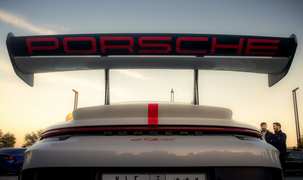
The 918 Spyder marked a turning point where hybrid technology became an asset rather than a compromise for performance. Its 4.6-liter V8 was based on the RS Spyder, an LMP2 prototype that conquered the 24 Hours of Le Mans. By pairing this high-revving race engine with cutting-edge electric motors, Porsche achieved a 0-60 time that shattered records. This vehicle proves that the future of motorsport DNA is inherently tied to the intelligent use of electric power.
Porsche Carrera GT: The V10 Masterpiece
Often regarded as the greatest analog supercar ever produced, the Carrera GT’s 5.7-liter V10 was originally a secret project for a Formula 1 engine that never saw the grid. When Porsche repurposed it for their flagship supercar, they unleashed an engine that revs with the speed and acoustic intensity of a race car. It is a demanding, rewarding vehicle that serves as a monument to engineering without the interference of modern electronic stability crutches.
Why Your Next Investment Should Be Driven By Engineering Excellence
For the discerning buyer or collector, the value of these vehicles is not just in their rarity, but in the integrity of their engineering. When you invest in a car with genuine racing roots, you aren’t just buying a vehicle; you are buying a piece of history that has been tested against the best in the world.
These production vehicles offer a driving experience that modern, highly-sanitized luxury cars struggle to replicate. The shift toward electrification is currently redefining how we approach the track, but the core principle remains: the best cars are those born on the asphalt of the world’s most demanding circuits.
If you are looking to add a piece of racing history to your own garage, now is the time to analyze the market and identify models that are currently appreciating in value. Whether you are an enthusiast tracking your performance metrics or a collector seeking the next blue-chip asset, our team of experts is here to guide you through the vetting process. Contact us today to schedule a consultation on acquiring your next high-performance machine.